
Nexix — Procedural Universe API (Public Demo)
A downloadable tool
Nexix — Procedural Universe API (Public Demo)
Nexix is an experimental simulation platform designed to generate and expose structured, persistent universes through a clean, developer-facing API.
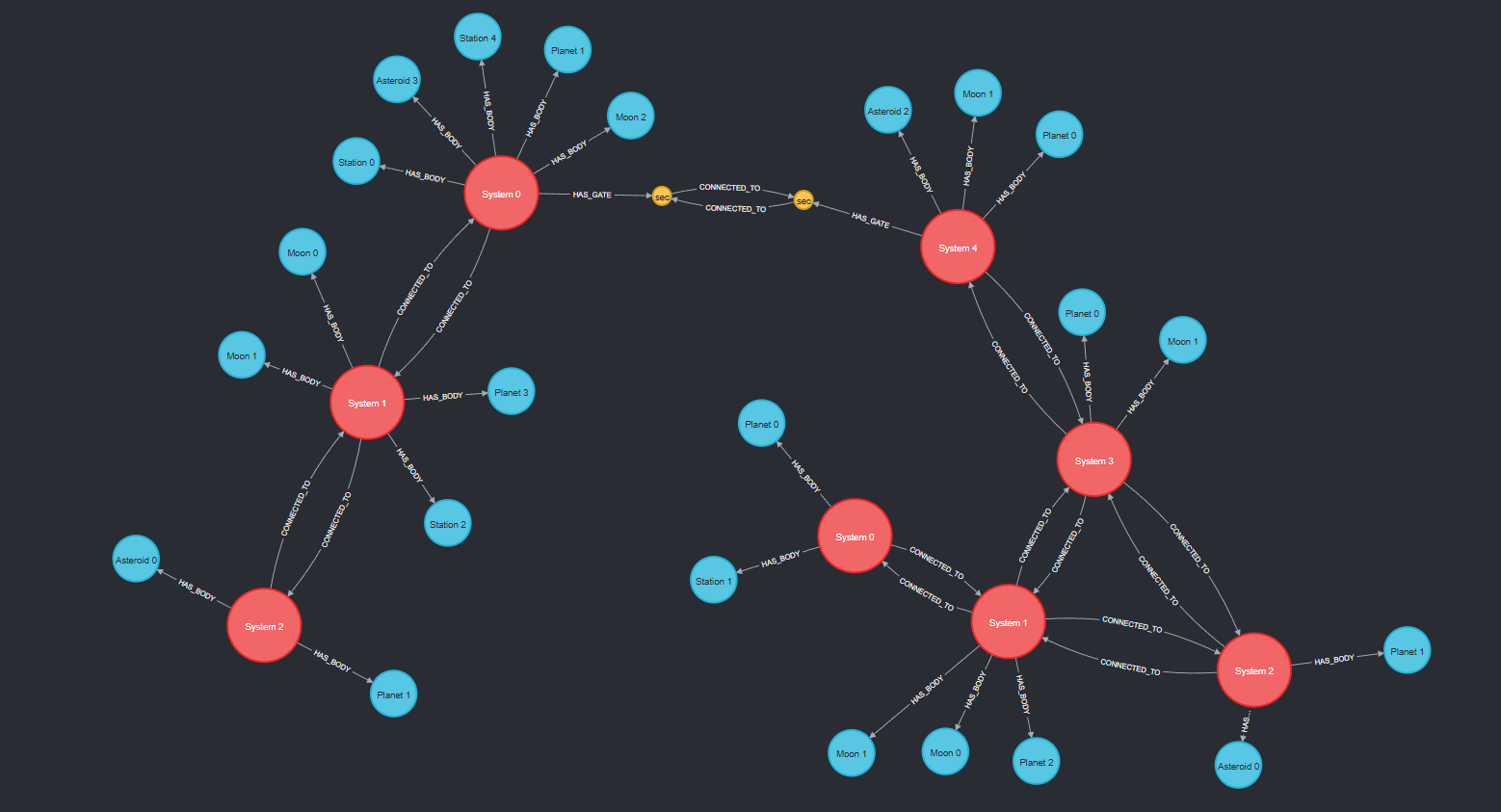
This project is a public demo showcasing a minimal reference universe: a procedurally generated spatial topology composed of sectors, systems, and traversal links. The intent is not to deliver a complete product, but to provide a tangible glimpse into how Nexix models large-scale worlds as data rather than static content.
What This Demo Provides
This release exposes a free, read-only HTTP API that allows developers to:
- Query a small, seeded universe
- Explore sectors and star systems
- Inspect structural relationships and topology
- Use the universe as test data, inspiration, or a prototyping aid
The universe is intentionally constrained in scope. It is stable, deterministic, and designed to be easy to integrate with existing tools, engines, or pipelines.
No authentication, no hidden mechanics, no vendor lock-in — just structured world data.
What Nexix Is (Conceptually)
Nexix is being developed as a simulation substrate, not a game engine.
The long-term vision is to provide modular “universes” that can be consumed by games, simulations, worldbuilding tools, or narrative systems. These universes are modeled as evolving graphs rather than handcrafted maps, enabling:
- Large-scale procedural consistency
- Logical relationships between entities
- Future extensibility across multiple domains
This demo represents the spatial layer of that vision.
What This Is Not
To set expectations clearly:
- This is not a finished product
- This is not a hosted service with SLAs
- This is not a promise of specific future features
The demo exists to validate ideas, gather feedback, and establish a baseline for how Nexix exposes simulated worlds to external systems.
Why Release This Publicly?
Releasing this demo early serves three purposes:
- To make the concept tangible
- To observe real-world API usage patterns
- To open a low-friction entry point for developers interested in procedural systems
If this direction resonates, Nexix will continue evolving iteratively and transparently.
Status
- Active development
- API stability not guaranteed
- Schema may evolve
Documentation is intentionally lightweight at this stage.
Closing Note
If you are experimenting with procedural worlds, simulation-driven design, or data-centric worldbuilding, this demo is intended to be a useful reference — nothing more, nothing less.
Nexix is at an early stage. This is simply the first visible layer.
API Response Overview
All API endpoints return graph-structured data encoded as JSON.
Top-level structure:
nodes: list of entities in the universerelationships: list of connections between entities
{ "nodes": [...], "relationships": [...] }
Nodes
Each item in nodes represents a single entity in the universe.
Node Object Fields
idInternal graph identifier. Stable for the lifetime of the universe seed.labelsArray of semantic labels describing the node type.propertiesObject containing domain-specific attributes.
Node Types
Universe
Root node representing the entire universe.
Properties:
id: public universe identifiercreated_at: ISO timestamp of creationtick: simulation tick (static in this demo)
Sector
High-level spatial region containing multiple systems.
Properties:
id: sector identifiername: human-readable name
System
Star system within a sector.
Properties:
id: system identifiername: human-readable name
Body
Physical object contained within a system.
Properties:
id: body identifiername: human-readable nametype: one of:- planet
- moon
- asteroid
- station
Gate
Traversal construct used to connect distant regions.
Properties:
id: gate identifier
Relationships
The relationships array defines how nodes are connected.
Relationship Object Fields
idInternal relationship identifiertypeSemantic meaning of the relationshipstartNodeSource node IDendNodeTarget node IDpropertiesReserved for future use (empty in this demo)
Relationship Types
HAS_SECTORUniverse → Sector containmentHAS_SYSTEMSector → System containmentHAS_BODYSystem → Body containmentHAS_GATESystem → Gate associationCONNECTED_TOTraversal link between systems or gates
Note: Bidirectional traversal is represented explicitly using two opposing CONNECTED_TO relationships.
Usage Notes
- API is read-only
- Schema may evolve over time
- No ordering guarantees are provided
- Consumers are expected to resolve hierarchy and traversal logic client-side
Design Intent
This API exposes structure, not behavior.
The graph-native format is designed to:
- Support procedural world exploration
- Enable client-side simulation or visualization
- Remain engine- and framework-agnostic
This document reflects the current demo only and does not imply future feature commitments.
Download
Click download now to get access to the following files:
Leave a comment
Log in with itch.io to leave a comment.